

 Employ 4 best practices to achieve customer experience excellence
Customers notice–the ease or hassle of doing business with you. The more touchpoints you have, the more opportunities for breakpoints. There’s more to understanding the customer experience than examining a specific transaction. To create the best experiences for your customers, you need to understand the complete sum of experiences that customers go through when interacting with your company. It means taking an outside-in view and stepping into you customers’ shoes.
Addressing customer experience requires data and a customer-centric approach. Seems simple enough, right? So why do only 8% of customers feel great about their experiences? Unless you work in one of the rare organizations where customers rate their experience as great, improving customer experience needs to move to the front burner. According to a Forrester study, by 2020, customer experience will overtake product and price as the key brand differentiator.
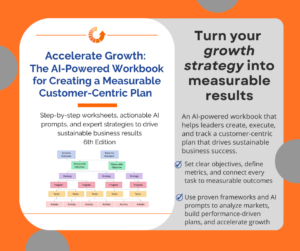
Buy Your Best-Practices Workbook
Employ These Four Best Practices to Achieve Experience Excellence
Customer experience is an opportunity to increase your competitive advantage. Marketers serving as value creators for their organization understand that there is a direct connection between customer experience and market leadership. In their pursuit of achieving customer experience excellence, they employ these four best practices:
- Connect customer experience and associated metrics to business outcomes
- Map key customer touchpoints and identify potential breakpoints
- Capture perception and expectation data for each interaction point
- Develop systems, tools, processes, skills and content to deliver a differentiated experience
The first two, Connecting Customer Experience and Business Outcomes and Mapping Touchpoints and Breakpoints, provide the starting point. Why? Because you can’t achieve business outcome goals such as market share, category ownership, and customer lifetime value without addressing customer experience. Repeat purchase, advocacy/referrals, faster adoption rates for new products/services, brand preference, and increased footprint/share of wallet among customers are also dependent on offering and providing a great experience.
Best-in-Class Marketing organizations understand that impacting and contributing to these business outcomes is affected as much by what happens “after the sale” as what happens “before the sale”. They think beyond the buying process and customer acquisition, working from specific quantifiable targets for outcomes and creating measurable marketing objectives associated with customer retention and growth. This means they match touch points to each and every point along the customer journey, from awareness to discovery, from contact to each buying interaction, from consumption to usage, and from cultivation and advocacy to community.
Take A Customer-Centric View
Make mapping the customer journey, identifying all the interaction touch points (and therefore the potential breakpoints), and assessing expectations versus perception, your plan to tackle and accomplish sooner rather than later. We can help.
For marketers to achieve business outcomes and their own objectives and metrics, you need to take a customer-centric view of the entire experience. It will take work, and you will want to validate the map with customers; the good news is that this provides you with a great opportunity to interact with your customer advisory board.
FAQ:
A: Customers experience your brand through the ease—or hassle—of every interaction. More touchpoints create more opportunities for breakpoints, and customers judge you on the complete sum of experiences, not a single transaction.
A: It means stepping into the customer’s shoes and evaluating the experience from their perspective across the full relationship lifecycle—before the sale, during purchase, and after the sale.
A: Because improving CX requires data, cross-functional coordination, and a customer-centric operating approach—not isolated fixes. The persistent gap (where only a small percentage of customers feel great about their experiences) signals that most organizations still manage CX too internally and too transactionally.
A: Research cited indicates customer experience is becoming a primary differentiator—overtaking product and price as a key brand differentiator—making CX essential to competitive advantage.
A:
- Connect CX and CX metrics to business outcomes.
- Map key touchpoints and identify potential breakpoints.
- Capture perception and expectation data for each interaction point.
- Develop the systems, tools, processes, skills, and content required to deliver a differentiated experience.
A: Because you cannot achieve outcomes such as market share, category ownership, and customer lifetime value without addressing CX. Retention, advocacy, adoption rates, brand preference, and share of wallet are all dependent on experience quality.
A: They recognize that “after the sale” impacts outcomes as much as “before the sale.” They set quantifiable targets for retention and growth, define measurable objectives, and match touchpoints across the entire journey—from awareness and discovery through consumption, usage, advocacy, and community.
A: Map the customer journey, identify all interaction touchpoints (and potential breakpoints), assess expectation vs. perception at each point, and validate the map with customers—often through customer advisory boards—to ensure the work reflects reality and drives meaningful improvement.
Recent Posts
- Focus on Solving Customer Pain Points to Future-Proof Your Company | What’s Your Edge?
- Customer-Centricity in M&A: The Accelerant for Post-Deal Value
- How Strategic Clarity Drives Growth, Profitability, and Customer Value
- Breaking Through Stagnant Growth with a Customer-Centric, Process-Driven Approach | WYE?
- Why Lack of Accountability is Stalling Your Organization’s Growth


You must be logged in to post a comment.