
Marketing accountability receives plenty of attention! There are numerous articles on the topic. If you search on Marketing accountability over 80,000 and counting items are served up. Many leaders responsible for Marketing lament that accountability, measurement, dashboard, and performance management remain a major challenge despite investments in analytics and technology.
One of the key reasons this challenge persists is the lack of focus on the metrics that matter to CEOs and the business. Gartner claims CMOs are on the hook to prove their value and that this is one of the primary reasons Marketing budgets end up on the chopping block. To address Marketing accountability it is imperative that marketers better quantify and measure the value of Marketing.
This emphasis on Marketing accountability looks like it is going to remain an above-the-line topic for the foreseeable future. If you are like many Marketing organizations, you’ve invested in web analytics tools, marketing campaign management systems, sales force automation, SEO tools, ABM platforms, and probably more. Maybe you’re asking yourself what more can I do?
Five Best Practices for Every Marketing Leader for Any Time of the Year!
Best Practice 1: Focus on business outcomes
When was the last time you marketed to a bucket of revenue? The lack of quantifiable specific outcomes related to the number of customers to acquire, retain, and grow in a market or segment hampers our accountability and as a result our performance management. If we don’t understand what needle to move, then how can we prove we’re moving it? Engage your leadership team to set quantifiable specific outcomes related to the number of customers to acquire, retain, and grow in a market or segment. Resolve to create a direct line of sight between marketing activities and business results.
The difficulty in linking the contribution of Marketing investments to and impact on the business in a definitive way is due to how it tracks activities through to business outcomes. Part of the problem is in the Marketing planning process. So often the plan is an extensive Word or powerpoint document that culminates in a calendar and budget worksheet. The relationship between the activities on the calendar and the business becomes blurred. While the work associated with the planning effort is extremely important, the resulting document isn’t a useful day-to-day tool. Commit to improving the link between Marketing and business results. One option is to use a mapping methodology.
Best Practice 2: Select outcome-based metrics
Too many Marketing programs lack a performance target and those that have one are typically volume-oriented output-based metrics. These metrics are often related to website traffic, downloads, and site behavior or social media behavior. Most marketers remain challenged with defining metrics and measurement from lead-to-pipeline-to-revenue. It’s time to focus on metrics related to customer management, market outcomes, and Marketing management; that is to move from output to outcome-based metrics, such as pipeline contribution, retention rates, referral rates, product adoption, and share of wallet. Vow to include a performance target tied to an outcome-based metric for every program.
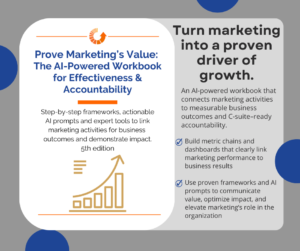
Buy Your Best-Practices Workbook
Best Practice 3: Hone your data, analytics, and measurement skills
You may have the web and marketing automation tools that provide instant insight into campaign activity but they won’t take you far if you don’t have the data, analytical, and measurement skills. Many organizations have invested in information-centric technology to support segmentation, personalization, content management, customer touchpoints, and sales force automation. Analytics is the missing link that enables you to truly leverage these investments. Improving your data and analytics skills will make it possible to evaluate data and make better decisions. Over the years researchers from Forrester, Jupiter, Ovum, and others along with our benchmark studies analyzed the impact of analytics on performance. Like us, they found that marketers using analytics can focus their spending on the areas of greatest return and are able to move from blind acquisition to intelligent acquisition, retention, and value.
Best Practice 4: Produce an actionable dashboard
 The ability to easily collect, track, and report on Marketing performance can make the difference in a consistent and effective Marketing Performance Management (MPM) practice. Investment in this area is critical. Systems that allow access to critical data elements and automatically visualize the data for Marketing allow for faster and more frequent assessment of marketing accountability and effectiveness. When these systems are not in place or lacking, they can cause Marketing to focus on metrics that they can track vs. what they should. Tracking and measuring what you can is not the same as measuring and reporting on what matters.
The Marketing dashboard graphically represents marketing performance. A good dashboard is actionable. It enables the marketing organization to understand what is and isn’t working and, if necessary, make appropriate course adjustments. Having a dashboard is one indicator of MPM maturity. Make this the year you work from a dashboard that enables the organization to see Marketing’s contribution to the business, manage performance, and facilitate better strategic decisions.
Best Practice 5: Operationalize Your Marketing
Success with the first four best practices requires marketing to take a more operational approach. You may know what you need to do but without the systems and processes associated with data collection, performance management, and reporting achieving them may just be a pipe dream. Create a Marketing Operations function that ties together analysis with performance management, builds and manages the infrastructure necessary to maximize marketing effectiveness and optimize Marketing performance, and moves Marketing closer to operating as a Center of Excellence.
Need help implementing and improving your Marketing accountability, performance management, and/or dashboards? This is our passion and expertise. We’d love to talk with you.
FAQ:
A: Many Marketing leaders invest in analytics and technology (web analytics, marketing automation, SEO tools, ABM platforms, sales force automation, and more) yet still struggle with accountability because they are not consistently measuring what matters most to CEOs and the business. When metrics don’t connect to business outcomes, Marketing’s value is harder to quantify—and budgets become easier to cut.
A: Gartner has noted that CMOs are on the hook to prove Marketing’s value. When Marketing cannot quantify and measure contribution in business terms, leadership may view spend as discretionary rather than strategic.
A: Focus on these five best practices:
- Focus on business outcomes
- Select outcome-based metrics
- Hone data, analytics, and measurement skills
- Produce an actionable dashboard
- Operationalize Marketing
A: It means defining quantifiable outcomes tied to acquiring, retaining, and growing customers in specific markets or segments—and creating a direct line of sight between Marketing activities and business results. Without clarity on “what needle to move,” Marketing cannot credibly prove it is moving it. One practical way to strengthen this linkage is to use a mapping methodology so the plan functions as a day-to-day management tool—not just a calendar and budget worksheet.
A: It means moving beyond volume-oriented, output-based metrics (traffic, downloads, social behavior) and adopting metrics tied to customer management, market outcomes, and Marketing management. Examples include pipeline contribution, retention rates, referral rates, product adoption, and share of wallet. Every program should have a performance target tied to an outcome-based metric.
A: Tools can surface activity, but analytics converts data into decisions. Many organizations have invested in information-centric technology for segmentation, personalization, content, customer touchpoints, and sales enablement—yet analytics is the missing link that enables teams to evaluate performance and optimize spend. Research across firms such as Forrester, Jupiter, and Ovum (along with benchmark studies) has consistently shown that marketers who use analytics can focus spending on areas of greatest return and move from blind acquisition to intelligent acquisition, retention, and value.
A: An actionable dashboard makes it easy to collect, track, and report performance frequently, and it clearly shows what is and isn’t working so teams can make course corrections. Dashboards are also an indicator of Marketing Performance Management (MPM) maturity. When systems are weak, teams tend to measure what they can track instead of what they should track—yet measuring what you can is not the same as measuring what matters.
Recent Posts
- Focus on Solving Customer Pain Points to Future-Proof Your Company | What’s Your Edge?
- Customer-Centricity in M&A: The Accelerant for Post-Deal Value
- How Strategic Clarity Drives Growth, Profitability, and Customer Value
- Breaking Through Stagnant Growth with a Customer-Centric, Process-Driven Approach | WYE?
- Why Lack of Accountability is Stalling Your Organization’s Growth


You must be logged in to post a comment.