
Do Marketing and Sales Agree on the Definition?
You’ve heard it before. The request for Marketing to “produce more qualified opportunities at a lower price”. Of course, different companies often have different definitions of a qualified customer opportunity. This may explain why a study by Marketing Sherpa found that of the 61% of Marketing organizations send all leads directly to Sales; however, only 27% of those leads will be qualified. This is why it is critical for Marketing and Sales within the same company to have the same definition.
Getting a clarity around the definition of a qualified buying opportunity. This is generally defined as
- a potential customer who has expressed interest in a product or service AND
- who meets general buying criteria AND
- has exhibited buying behavior
Ideally a qualified opportunity meets ALL three of these criteria.
Qualified buying opportunities are the bridge between initial contact and a won customer who generates revenue. All the contacts and connections with the customer become valuable once they are sales ready and worthy. Therefore it’s essential that Marketing knows how to create more qualified opportunities that quickly convert to sales ready status before a competitor contacts them or they go cold.

Four Components to Producing More and Better Qualified Opportunities
Marketers use a variety of upstream methods (segmentation, profiling, personas, positioning, messaging, and journey mapping, etc. ) and downstream demand gen tactics ( PR/social, advertising, events, web, email, direct mail, and so on) to produce qualified opportunities that the Sales can convert into customers.
The key is for Marketing to target the right customers at the right time with the right message and the right offer. Seems obvious, but this simple sentence reveals the four ingredients marketers need:
1. Right Prospect. Understanding who the right prospect is requires doing your homework – often in the form of conducting research on your customers. It takes data to create target segments and personas and insights to be able to connect these to each other. Ideally, using analytics, Marketing will come to understand the customer better than the customer understands itself.
2. Right Time. Marketing should clearly understand the triggers that initiate the customers buying process. Mapping the customer journey is a good place to start to understand triggers and the customer buying process.
3. Right Message. While personalization and customization are critical to successful marketing efforts, the message needs to resonate with the customers and be delivered in the right channel.
4. Right Offer. People want to solve a problem; the offer Marketing extends needs to demonstrate that the organization understands the problem and has the best or most optimal way to solve it.
Once you have mastered all four ingredients, Marketing and Sales need to collaboratively develop an opportunity scoring methodology and model. This may seem obvious but 79% of B2B companies have not established lead scoring methodology. Qualified buying opportunities that meet the definition and achieve the appropriate score are the ONLY opportunities that should be delivered to Sales to pursue and convert to customer.
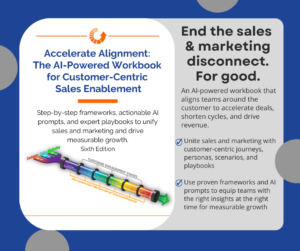
Buy Your Best-Practices Workbook
If you are going to go to the effort of generating these, it makes sense to invest in a way to track these through the buying process. This means you will need processes and systems to monitor the results of your demand generation initiatives. These are vital to being able measure and manage the number of opportunities produced and how, the number and characteristics of these became qualified, and how many of the opportunities converted to customers.
FAQ:
A: Misalignment leads to inefficiencies—Marketing may send many unqualified leads, burdening Sales and reducing conversion rates. Clear, shared definitions ensure focus on opportunities most likely to convert, improving pipeline quality and revenue outcomes.
A: Ideally, a qualified opportunity:
- Expresses genuine interest in your product or service
- Meets general buying criteria (fit, budget, authority)
- Exhibits buying behavior (engagement, intent signals)
All three criteria should be met for optimal qualification.
A:
- Right Prospect: Deep customer research and analytics to identify and segment ideal buyers.
- Right Time: Understanding customer buying triggers via journey mapping and behavioral insights.
- Right Message: Personalized, resonant messaging delivered through preferred channels.
- Right Offer: Solutions that clearly address customer problems with compelling value.
A: They should jointly develop and agree on a lead/opportunity scoring methodology that quantifies fit, engagement, and intent, ensuring only qualified opportunities meeting threshold scores are passed to Sales.
A: Approximately 21%—meaning 79% have not, highlighting a significant opportunity for improvement.
A: It enables measurement and management of demand generation effectiveness, qualification rates, and conversion performance, providing actionable insights to optimize Marketing and Sales alignment and investment.
A: VisionEdge Marketing offers advisory services to facilitate consensus-building, design scoring methodologies, and implement tracking systems that enhance pipeline quality and revenue growth.
Recent Posts
- Focus on Solving Customer Pain Points to Future-Proof Your Company | What’s Your Edge?
- Customer-Centricity in M&A: The Accelerant for Post-Deal Value
- How Strategic Clarity Drives Growth, Profitability, and Customer Value
- Breaking Through Stagnant Growth with a Customer-Centric, Process-Driven Approach | WYE?
- Why Lack of Accountability is Stalling Your Organization’s Growth


You must be logged in to post a comment.