
We often talk about the value of Marketing. To play a strategic, indispensable role, Marketing needs to be valuable. Does it seem like I’m splitting hairs? These two words may seem similar, but the meaning is not. The dictionary tells us that “value” is the degree to which something is useful or estimable. Something that is valuable, on the other hand, is something that is precious and of great worth, and therefore important. The distinction is  important because while value may be appreciated, it may not be necessary or important. Something that is valuable, however, is something that is of great importance, utility, or service; it is essential to the working of the organization. Valuable is indispensable. Valuable organizations participate in the decision-making process.
While every Marketing organization wants to be useful, who wouldn’t want to be considered indispensable? Here’s an illustration of the idea. When you collect and analyze data to understand customer purchasing patterns, create a new piece of content, or execute an email campaign, your leadership team may value the work. But that doesn’t always mean it is considered valuable. There are serious implications to being valued but not valuable. Valued organizations will be given some resources (people and cash) to continue to be productive, but additional resources are harder to come by, may require more justification, or worse, can be taken away. It probably goes without saying that if a Marketing organization isn’t even perceived to be of strategic value, it won’t be long before that organization sees budget cuts and headcount reductions. If the organization could ultimately operate without Marketing’s work product, it may be valued, but not valuable.

 While every Marketing organization wants to be useful, who also wouldn’t want to be considered indispensable?
6 Ways to Make Your Marketing Organization More Valuable
If you want to secure and keep your Marketing budget, focus on being valuable and strategic. Art Petty, an author and teacher on management and leadership, asserts that people and functions are more valuable when they are aligned to the leadership priorities, help mitigate or eliminate problems, bring recommendations to the table, and build bridges across the organization. Using these ideas, and others gleaned from CMOs in best-in-class Marketing organizations, we’ve crafted a list of 6 ways to make your Marketing organization indispensable.
- Alignment: Focus the work of Marketing around the priorities, strategy, and outcomes of the organization. Be clear about what constitutes success and be sure the Marketing plan, team, investments, and programs are all synced up to these outcomes. What you do needs to matter and make a difference to the business. It’s not the quantity of your to-do list or how many of the items you complete that make you a valuable marketer or employee. Being able to make good strategic decisions about what’s important and prioritizing work so that what you are tackling will demonstrate that you know what is valuable to the company. Look for opportunities where your work will improve customer satisfaction and experience, create money for the company, such as accelerating customer acquisition or growing customer share of wallet, and save the organization money.
- Accountability: Be able to quantify the value of the work of Marketing to the leadership team in measures and metrics that matter to the C-Suite.
- Anticipate: Marketing needs to be about more than the execution of demand generation and branding programs. A valuable Marketing organization has the periscope up at all times in order to help the organization anticipate competitors’ moves, customer requirements, industry trends, and market changes. Listen and learn about customers and bring insights to the table that will help the leadership team navigate the market. Valuable Marketing organizations have a cadence of collecting and sharing critical information that the leadership needs for strategic and tactical decision-making.
- Forge alliances. Marketers and Marketing cannot operate as a silo or see themselves as merely a service center for sales. Marketers have a tendency to be head down in tactics. According to the Corporate Executive Board (CEB) research, only 40% of employees work with more than 20 people on a given day, and more than 80% only work with 10. Your network needs to expand beyond other marketers or the Sales team. Build bridges with members of the business, operations, finance, and IT teams, as well as externally. External relationships enable Marketing to bring in an outside-in view of the market, competition, and industry. Find ways to develop more contacts and expand your network. Give your network reasons to want to work with you versus someone else.
- Serve as a trusted advisor. To be a trusted advisor, your leadership team needs to have confidence that you and your team have the experience, training, knowledge, and expertise to support the business. You know Marketing is a trusted advisor when the leadership team brings Marketing into decision-making discussions early and turns to Marketing for input on general business issues and specific customer issues.
- Be a change agent. Your organization must constantly adapt and adjust to the market, competitors, and customers. Take the lead on embracing change and helping the organization make change a positive process.
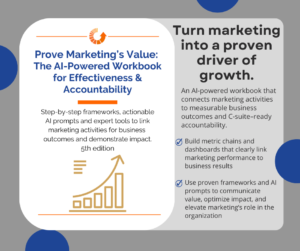
Buy Your Best-Practices Workbook
Each of these is important to tackle – the security of your organization and its budget is riding on it. Completing your own work and solving problems within your own function provides value. If you want to be valuable, it will take more than hard work and effort. Need help determining how to make the extra leap from creating value to being valuable? Send us an email.
FAQ:
A: Value is usefulness—work that is appreciated or estimable. Valuable, however, means indispensable—work of great worth that is essential to the organization’s success. The distinction matters because a Marketing team can produce work leaders “value” (content, campaigns, analysis) without being seen as strategically necessary to decision-making and growth.
A: Because being valued is not the same as being protected. Valued organizations may receive enough resources to stay productive, but incremental investment is harder to secure and easier to cut. If leadership believes the organization could operate without Marketing’s work product, Marketing may be appreciated—but not indispensable—making it vulnerable to budget and headcount reductions.
A: It participates in decision-making, helps leadership navigate uncertainty, and consistently demonstrates measurable contribution to business outcomes. It is not merely executing activities; it is shaping priorities, guiding investments, and improving performance in ways the C-Suite recognizes as essential.
A:
- Alignment
Sync Marketing priorities, strategy, investments, and programs to enterprise outcomes. Define success clearly and prioritize work that improves customer experience, accelerates acquisition, grows share of wallet, and/or reduces cost. Being valuable is not about completing a long to-do list; it is about making strategic choices that matter to the business. - Accountability
Quantify Marketing’s contribution using measures and metrics that matter to the C-Suite. Indispensable Marketing makes performance visible and decision-grade. - Anticipate
Keep the periscope up. Bring insights about competitors, customer requirements, industry trends, and market shifts into leadership conversations. Establish a cadence for collecting and sharing the information leaders need to make strategic and tactical decisions. - Forge alliances
Operate as a cross-functional bridge, not a silo or a “service center.” Expand relationships beyond Marketing and Sales into operations, finance, IT, and external networks. An outside-in perspective strengthens strategic relevance and helps Marketing bring differentiated insight to the table. - Serve as a trusted advisor
Build confidence through experience, training, knowledge, and expertise. You know Marketing is trusted when leaders involve Marketing early and seek input on business and customer issues—not just on campaigns. - Be a change agent
Markets shift; customers change; competitors move. Valuable Marketing leads change, helps the organization adapt, and makes change a positive, managed process rather than a reactive scramble.
A: Completing work and solving functional problems creates value. Becoming indispensable requires more: aligning to leadership priorities, proving contribution in business terms, anticipating what’s next, building cross-functional bridges, earning trusted-advisor status, and leading change. That is how Marketing protects budget, increases influence, and becomes essential to the organization’s operating system.
Recent Posts
- Focus on Solving Customer Pain Points to Future-Proof Your Company | What’s Your Edge?
- Customer-Centricity in M&A: The Accelerant for Post-Deal Value
- How Strategic Clarity Drives Growth, Profitability, and Customer Value
- Breaking Through Stagnant Growth with a Customer-Centric, Process-Driven Approach | WYE?
- Why Lack of Accountability is Stalling Your Organization’s Growth


You must be logged in to post a comment.