

A Massachusetts Institute of Technology study found that agile firms grow revenue 37% faster and generate 30% higher profits than non-agile companies. Articles in Forbes Magazine emphasize that the acceleration of changes in customer preferences, the market landscape, and technology, coupled with the explosion of data, requires Marketing organizations to be more agile. Agility enables them to adapt their Marketing efforts, quickly and successfully, in response to changing customer behavior, market conditions, and business direction, to the benefit of improved market share and/or customer value.
Marketing effectiveness, Marketing accountability, and Marketing measurement are three distinct, yet complementary, performance management concepts.
- Marketing accountability reflects Marketing’s ability to explain the basis for its actions. It implies both a measurement and computational aspect and covers a range of marketing capabilities, processes, and metrics.
- Marketing effectiveness measures Marketing’s ability to produce a specific result.
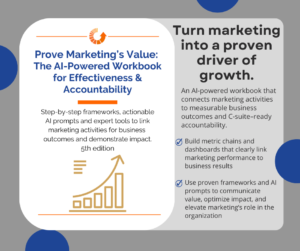
Buy Your Best-Practices Workbook
How Three Capabilities Ramp Up Your Marketing Effectiveness and Performance

Our work and that of others have found that best-in-class Marketing organizations develop knowledge, skills, and processes and deploy systems and tools related to managing and enhancing the connection between customers, products, and service delivery. Whether you are just starting your performance management journey or are well on your way, you can learn from those who excel in their pursuit of excellence. Even the best athletes and performers train and employ coaches.
Optimize Your Performance Management Processes and Marketing Operations
The increased focus on agility and effectiveness necessitates every Marketing organization establish some capability known as Marketing Operations (Marketing Ops). Marketing Ops plays a central role in improving Marketing’s ability to deliver on performance measurement and management, and enables Marketing to operate as a Center of Excellence.
Achieving agility, cultivating Marketing effectiveness, and driving performance improvements requires Marketing Ops to cultivate a number of critical proficiencies, including data, analytical, measurement, skills, processes, and technological muscle.
Marketing Ops serves as a conduit between Marketing, Sales, Finance, and the executive team. It facilitates and orchestrates the work of marketing – running marketing like a business. How? Marketing Ops is the infrastructure, the mechanism, and the engine that helps your Marketing be more agile and generate more value for the business.

Marketing’s value is derived from its ability to develop knowledge and skills that define market opportunities and design and implement the strategy that connects customers with products. Marketing operational excellence is the domain of Marketing Ops. Once you have it in place, it helps you select and implement the right tools to facilitate process efficiencies, better and faster decisions, consistent workflows, enhanced connectivity, alignment, collaboration, and investment management.
It is your Marketing Ops that develops and implements the:
- Processes, systems, and skills necessary for Marketing to drive business results
- Data capabilities needed to make strategic decisions related to customers, the market and products, to make course corrections
- Framework to measure and report on Marketing performance
These capabilities are the ingredients for developing a highly functional Marketing organization- one focused on improving efficiencies and effectiveness. Why does this matter? Firms with highly functional Marketing organizations experience more innovation, market share, growth and profit.
Marketing Operations develops and implements the processes, systems, tools, and skills necessary for Marketing to drive business results, to use data to make strategic decisions related to customers, the market and products, to make course corrections, and to measure and report on Marketing performance.
We have identified 27 distinct operations that comprise the marketing workflow. These 27 workflow operations are grouped into five key marketing areas:
- strategic marketing (Upstream Marketing and pre-sale)
- product Marketing/go-to-market
- opportunity development
- Post-sale/customer Marketing
- Marketing performance management
Your Marketing operations play a role in each of these. Contact us if you’d like to assess and enhance your marketing organization’s workflow proficiency. The Marketing Workflow Skills Assessment section of the MarketStrength™ Audit tool explores an individual’s and a group’s skills related to these 27 Marketing workflow areas.

Utilize Technology to Achieve Operational Excellence
Tools can facilitate positive benefits such as process efficiencies, better and faster decisions, consistent workflows, enhanced connectivity and sharing, and so on.
In their study, “Realizing the Promise of Marketing Technology,” ITSMA defined marketing technology as “the software for improving marketing and sales processes to achieve business objectives.” This definition provides a way to frame the marketing technology (Martech) landscape, which currently consists of a very large and growing number of players and platforms. The options and platforms often include systems for managing digital assets, allocating resources, tracking marketing activity and expenditures, automating campaigns (online and offline), managing content, demand, and customer relationships, and measuring and reporting marketing performance.
The Martech landscape is vast and growing. It’s easy to be overwhelmed by all the options. The purpose of Marketing technology is to facilitate process efficiencies, better and faster decisions, consistent workflows, enhanced connectivity, alignment, collaboration, and investment management. At VisionEdge Marketing, we organize Martech into four broad categories:
- Market and customer intelligence and Insights for using data and analytics to identify customer and market opportunities
- Customer interaction and engagement for acquiring and keeping customers
- Project/Workflow/Operations management for managing the work of Marketing
- Performance management for improving and proving the value of Marketing
The right tools in the right hands enable you to find customers, keep customers, and grow the value of customers. It might be time to fashion a Marketing technology roadmap. Register and download the white paper Marketing Technology: The Power Tools for Optimizing Performance and Agility.
Ready to step up your game to create a fully functional Marketing Operations that will facilitate agility, performance management, and enable Marketing to serve as a Center of Excellence? Then let’s talk today.
FAQ:
A: MIT research found agile firms grow revenue 37% faster and generate 30% higher profits than non-agile companies. Accelerating changes in customer preferences, markets, and technology demand rapid adaptation.
A: They’re distinct but complementary: Accountability is explaining the basis for actions (measurement + computation), Effectiveness is producing a specific result, and Measurement is the data foundation for both.
A: They develop knowledge, skills, and processes—and deploy systems/tools—to manage the connection between customers, products, and service delivery.
A: MarketingOps is the infrastructure, mechanism, and engine that enables Marketing to operate as a Center of Excellence. It serves as a conduit between Marketing, Sales, Finance, and leadership—facilitating agility and performance management.
A: (1) Processes, systems, and skills to drive business results, (2) data capabilities for strategic decisions and course correction, and (3) frameworks to measure and report Marketing performance.
A: Strategic marketing (upstream/pre-sale), product marketing/go-to-market, opportunity development, post-sale/customer marketing, and marketing performance management.
A: Organize Martech into four categories: (1) market/customer intelligence for insights, (2) customer interaction/engagement for acquisition/retention, (3) project/workflow/operations for managing work, and (4) performance management for proving value.
A: Firms with highly functional Marketing organizations experience more innovation, market share, growth, and profit—because MarketingOps enables agility, process efficiency, better decisions, and consistent alignment across the organization.
Recent Posts
- Focus on Solving Customer Pain Points to Future-Proof Your Company | What’s Your Edge?
- Customer-Centricity in M&A: The Accelerant for Post-Deal Value
- How Strategic Clarity Drives Growth, Profitability, and Customer Value
- Breaking Through Stagnant Growth with a Customer-Centric, Process-Driven Approach | WYE?
- Why Lack of Accountability is Stalling Your Organization’s Growth


You must be logged in to post a comment.