
As you know, your car runs smoother and requires less energy to go faster and farther when the wheels are in perfect alignment. You perform better when your Marketing is in alignment with the business. Why? Because when Marketing is in alignment with the business, they are both more likely to travel in the same direction.
Alignment and accountability are the first steps every aspiring Marketing organization must take to improve its performance management and measurement (MPM). The Deloitte CMO study echoes our MPM benchmark studies conducted since 2001, demonstrating and communicating that the impact of Marketing on and to the business remains the number one challenge. Marketing’s Alignment and accountability are inextricably linked. They are the primary ingredients for addressing this challenge. They form the cornerstones for transforming Marketing into a center of excellence. Without alignment, it’s impossible to quantify Marketing’s value to the business, and to select the right metrics – metrics that measure whether you are doing the right things to generate value for the organization.
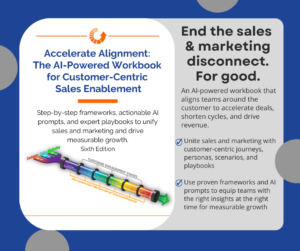
Buy Your Best-Practices Workbook
Let’s Be Sure We’re In Sync on Alignment
Just as your car can become undrivable if your alignment is too far out of whack, the most sophisticated data collection and analysis can be completely undermined by the lack of proper alignment. Best-in-class Marketing organizations create a direct line of sight between their Marketing investments, activities, and the business outcomes. Alignment enables Marketing to clarify the strategic intent of all the investments it makes, and to measure and communicate the degree to which Marketing delivers on its commitments.
First, let’s make sure we’re aligned on what alignment means.

Defining Alignment
Finding the right path to proper alignment can seem pretty confusing at first. Marketing groups often take a bottom-up approach to planning and focus on developing marketing programs that usually include some combination of what’s always been done and what they know best. Programs may not seem tightly connected to the business. The metrics typically used at the program level do not always demonstrate the connection between the broader business initiatives. Consequently, quantifying Marketing’s contribution to the business is difficult; the picture is hazy. This jeopardizes continued investments in Marketing and can obscure the steps Marketing should, and shouldn’t, be taking.
An outcome-based approach to alignment flips this problem on its head, creating a top-down perspective, starting with the business’s success factors and working “down the ladder” to reveal what Marketing can do to support the business. This means the Marketing key performance indicators (KPIs) will be more related to what the business is trying to accomplish, such as product adoption rate, customer lifetime value, than KPIs around Marketing activities, such as social engagement.
This approach to alignment provides greater clarity for how Marketing is expected to make a difference and provides you with that essential roadmap.
How do you know if Marketing is aligned with the business? Nearly two decades of research have provided insight into what sets Marketing organizations who’ve achieved alignment apart from their peers. Check to see how your organization stacks up.

 View
ViewThe Chain that Connects Alignment with Accountability
Metrics more on doing things right, efficiency, typically signal an alignment alert. If that’s your situation, give some thought as to how you will address improving alignment. There are many ways to address alignment. The most important consideration is to choose a method that will visually convey the connection and value between the work of Marketing and business results. Select an alignment approach that helps you build a chain of measures and metrics between your work and your contribution to the business. It is this chain that enables you to connect alignment with accountability.
By connecting alignment and accountability, you can focus on measuring and managing Marketing’s performance in a way that truly demonstrates Marketing’s ability to generate value and its contribution to the organization.

 Value-Impact Metrics Chains visually connect the work of Marketing to results. Source: VisionEdge Marketing. Derived from the patented Accelance(r) methodology.
Let’s talk about how to craft your metrics chains.
Is It Time For a Tune-Up?
Remember, just like a car – when Marketing is aligned to business, it too will run smoother and take less energy. The following checklist provides five clues as to where to start if you need to improve alignment.
- Create a direct line of sight between investments (money and people), objectives, program strategy, and tactics.
- Use your Marketing plan as an alignment tool.
- Prioritize Marketing projects based on their value and impact to broader organizational outcomes, not on what has the most political capital, is easiest to do, or is the furthest behind schedule.
- Clarify how each member of the Marketing team directly affects achieving the business outcomes.
- Focus your measures and metrics on doing the right things vs. doing things right.
Important instruments need calibration every now and then to maintain accuracy. You take your vehicle in for a tune-up to ensure top performance. It’s the same with Marketing. In both cases, you’re going to want to enlist the help of an expert to make sure everything gets examined thoroughly. Give us a call when you’re ready to have our Marketing mechanics take a look at your alignment.
FAQ:
A1: Because when alignment is off, you burn energy and drift off course. When Marketing is aligned with the business, both are more likely to move in the same direction—improving performance and reducing wasted effort.
A2: Because without alignment, accountability is impossible. If Marketing is not clearly linked to business outcomes, you cannot quantify value or select the right metrics—so dashboards and analytics become noise rather than performance management.
A3: Alignment is the ability to create a direct line of sight between Marketing investments and activities and the business outcomes they are expected to impact. It clarifies the strategic intent of investments and enables Marketing to measure and communicate delivery against commitments.
A4: Bottom-up planning. Marketing teams often build programs based on what they have always done or what they know best. Those programs can be loosely connected to business priorities, and program-level metrics rarely demonstrate contribution to broader business initiatives—making value hard to prove.
A5: It starts top-down with the business’s success factors and works “down the ladder” to define what Marketing must do to support them. This shifts KPIs from activity measures (for example, social engagement) to outcome measures (for example, adoption rate, customer lifetime value).
A6: When measures are dominated by “doing things right” (efficiency and activity) instead of “doing the right things” (outcome contribution). Efficiency-only metrics often indicate you are optimizing execution without confirming strategic relevance.
A7: A metrics chain—a visual, measurable chain that links investments and activities to outcomes and business results. This chain is what enables Marketing to demonstrate value, contribution, and impact in a way leadership can evaluate and act on.
A8: Create direct line of sight between investments, objectives, program strategy, and tactics; use the Marketing plan as an alignment tool; prioritize projects based on value and impact (not politics, ease, or urgency); clarify how each team member affects business outcomes; and focus measures on doing the right things versus doing things right.
Recent Posts
- Focus on Solving Customer Pain Points to Future-Proof Your Company | What’s Your Edge?
- The Destiny of Siloed Priorities is Random Acts
- The Power of Customer-Led Product Development for Market Growth | What’s Your Edge?
- Footprint Expansion: A Customer-Centric Growth Strategy for Scaling
- The Focus on Right-Fit Customers Yields Faster Profitable Growth | What’s Your Edge


You must be logged in to post a comment.