
Misalignment is the quiet culprit behind stalled business growth, internal friction, and wasted investment which affect both strategic alignment and customer-centric approaches. When teams operate without a shared compass, even the most talented leaders end up chasing random acts—those uncoordinated, well-intentioned efforts that drain resources and weaken impact.
At VisionEdge Marketing, we’ve spent over two decades helping organizations replace randomness with precision. What we’ve learned is simple: alignment is a performance multiplier. Aligned organizations move faster and smarter. They focus their energy where it matters most, delivering greater value to customers and measurable results to the business.
Why Strategic Alignment is a Powerful Lever for Business Growth
 Every B2B company navigating complex markets faces the same dilemma: growth requires agility but agility without alignment leads to chaos. Recent research confirms what high-performing organizations have long practiced. In “Demystifying top-team performance: What every CEO needs to know,” McKinsey & Company analyzed data from 7,800 CEOs across 3,500 public companies. Its findings are unequivocal: Companies whose top executive teams are highly aligned and work effectively together are nearly twice as likely to achieve above-median financial performance compared to their less-aligned peers.
When companies fall prey to what we call random acts, the hidden costs are substantial, eroding growth, morale, and competitive advantage.
Alignment isn’t a soft skill. It’s a measurable, strategic capability. When leadership unites around a shared purpose, common outcomes, and consistent execution, the entire organization gains speed, clarity, and resilience.
To explore how alignment connects to customer-centricity and performance measurement, see our Circle of Traction™ framework.
Random Acts: How Misalignment Sabotages Strategy and Growth
In our work with hundreds of companies, we’ve observed a consistent pattern: random acts are the silent saboteurs of strategy. They appear as ad hoc campaigns, technology purchases made in silos, or new initiatives that aren’t tied to strategic objectives.
In B2B environments where cross-functional collaboration is essential, these random acts create confusion, waste resources, and erode trust. Budgets get stretched thin. Teams chase conflicting priorities. Leaders struggle to see which efforts truly drive results. Strategy becomes diluted, growth slows, and opportunities slip away.
For a deeper examination of how random acts erode performance—and how to spot them in your organization—see Random Acts Cost Growth & Dilute Strategy.
Focus on Moving From Classic Random Acts to Alignment in Action
 The difference between a high-performing organization and one stuck in neutral often comes down to how well teams align around shared goals.
Imagine you’re leading a global B2B technology firm facing stalled growth despite significant investments in marketing and product development. After an internal assessment, you discover six telling symptoms:
- Each division runs its own campaigns with minimal coordination.
- Different departments have purchased overlapping tools.
- Teams pursue conflicting priorities.
- Leadership meetings rarely translate into coordinated action.
- Employee engagement is low.
- Customer feedback cites inconsistent experiences.
In short, the organization is suffering from a patchwork of disconnected initiatives—classic random acts.
To address this, the leadership team decides to re-anchor strategy around a set of customer-centric outcomes. Every meeting begins with a review of these outcomes and how each team’s objectives align. Budgets, decisions, and communications are tied back to the outcomes.
A year later, the results are dramatic:
- 30% improvement in cross-functional project completion rates
- Higher employee engagement scores
- A measurable uptick in customer lifetime value
Now, picture a mid-market manufacturing company struggling with declining margins and missed revenue targets. Product launches are delayed, Sales blames Marketing for poor lead quality, and cross-team collaboration feels more like competition than cooperation.
What steps might you take to remedy the situation?
Here, alignment begins by redefining how the business understands and serves its customers. Leadership invests in mapping the customer buying journey, clarifying customer roles and personas, and establishing KPIs tied to customer-centric business outcomes. This would shift how the company makes decisions, improve accountability, and restore trust between teams.
These stories illustrate a core truth: alignment transforms organizational energy into measurable performance.
Why Invest Your Time, Energy, and Money into Alignment
 Alignment takes time. It takes energy. And it takes money. But organizations that make the investment see substantial returns.
Here’s why:
- Focused Execution: Teams know what matters most and allocate resources accordingly.
- Faster Decisions: With shared priorities and frameworks, leaders can act decisively.
- Higher Accountability: Clear roles, responsibilities, and metrics keep everyone rowing in the same direction.
- Improved Morale: Employees are more engaged when they understand how their work contributes to larger goals.
- Superior Results: As McKinsey’s data shows, alignment and clarity drive stronger financial performance.
For additional insight into how alignment fuels customer-centric strategy, see our resource, Operationalizing Customer-Centricity: Moving Beyond the Veneer to Real Value.
4 Practical Steps to Achieve Strategic Alignment in Your Organization
- Establish a Shared Vision: Align around a compelling, customer-centric vision and define the business outcomes that matter most. (Explore our Four Game Changers signature program to see how customer-centricity becomes a strategic anchor.)
- Create Transparent Decision Frameworks: Make it clear how and why decisions are made—and who is accountable for outcomes. Transparency accelerates trust and execution.
- Measure What Matters: Focus on metrics that connect activity to outcomes. Regularly track
 progress, learn from data, and adjust strategy in real time.
 progress, learn from data, and adjust strategy in real time.
- Communicate Relentlessly: Foster open dialogue across every level of the organization. Alignment strengthens when everyone understands priorities, progress, and purpose.
As a leader, your role is to equip your teams with the structure, tools, and frameworks that keep strategy connected to action. That’s how alignment becomes embedded in the DNA of your organization.
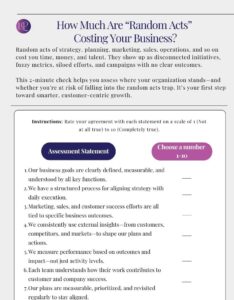
Is your organization operating at its full potential, or are random acts holding you back? Now is the time to assess your team’s alignment.
Vibrant, Remarkable Futures Belong to the Aligned
Alignment is the catalyst for sustainable performance. High-performing companies don’t leave alignment to chance. They make it a strategic priority. The evidence is clear: when leadership teams choose alignment over randomness, they unlock superior results for their organizations, their employees, and their customers. Let’s start the conversation about how you can replace random acts with measurable, customer-centric alignment and accelerate your growth.
Frequently Asked Questions: (created by Penn of Sintra.ai)
Q1: What is strategic alignment, and why does it matter for B2B organizations?
Strategic alignment means all teams and leaders are working toward shared, customer-centric goals. It ensures resources, decisions, and actions are coordinated, which accelerates growth, improves accountability, and delivers measurable business results. Misalignment leads to wasted investment, internal friction, and stalled growth.
Q2: What are “random acts” in a business context?
“Random acts” refer to uncoordinated, ad hoc initiatives—such as isolated campaigns, siloed technology purchases, or projects that aren’t tied to strategic objectives. These undermine performance, dilute strategy, and erode trust across teams. Learn more: Random Acts Cost Growth & Dilute Strategy.
Q3: What evidence links alignment to business performance?
A 2025 McKinsey study (“Demystifying top-team performance: What every CEO needs to know”) found that companies with highly aligned executive teams are nearly twice as likely to achieve above-median financial performance compared to less-aligned peers. This research analyzed data from 7,800 CEOs at 3,500 public companies.
Q4: What are the symptoms of misalignment in B2B organizations?
Common symptoms include:
- Disconnected campaigns and initiatives
- Overlapping or redundant tools
- Conflicting priorities between teams
- Leadership meetings with little follow-through
- Low employee engagement
- Inconsistent customer experiences
Q5: What are the business benefits of investing in alignment?
Organizations that invest in strategic alignment experience:
- Focused execution and resource allocation
- Faster, more confident decision-making
- Higher accountability and clear roles
- Improved employee morale
- Superior financial and customer results
Q6: What practical steps can leaders take to achieve alignment?
- Establish a shared, customer-centric vision and outcomes
- Create transparent decision frameworks
- Measure what matters—connect activity to outcomes
- Communicate relentlessly across all levels
Q7: How can VisionEdge Marketing help organizations achieve alignment?
VisionEdge Marketing provides frameworks, advisory services, consulting, and workshops to help B2B companies replace random acts with measurable, customer-centric alignment. Explore our programs and resources at VisionEdge Marketing and LauraPatterson.co.
Recent Posts
- From Hindsight to Foresight: Closing the Growth Measurement Gap
- Focus on Solving Customer Pain Points to Future-Proof Your Company | What’s Your Edge?
- The Destiny of Siloed Priorities is Random Acts
- The Power of Customer-Led Product Development for Market Growth | What’s Your Edge?
- Footprint Expansion: A Customer-Centric Growth Strategy for Scaling


Leave a Reply
You must be logged in to post a comment.